The Salty Mariner

Home

All Posts

Latest News

Maritime Companies

Training Centers

Useful Links

Contact

Published: August 16, 2026

12 min read
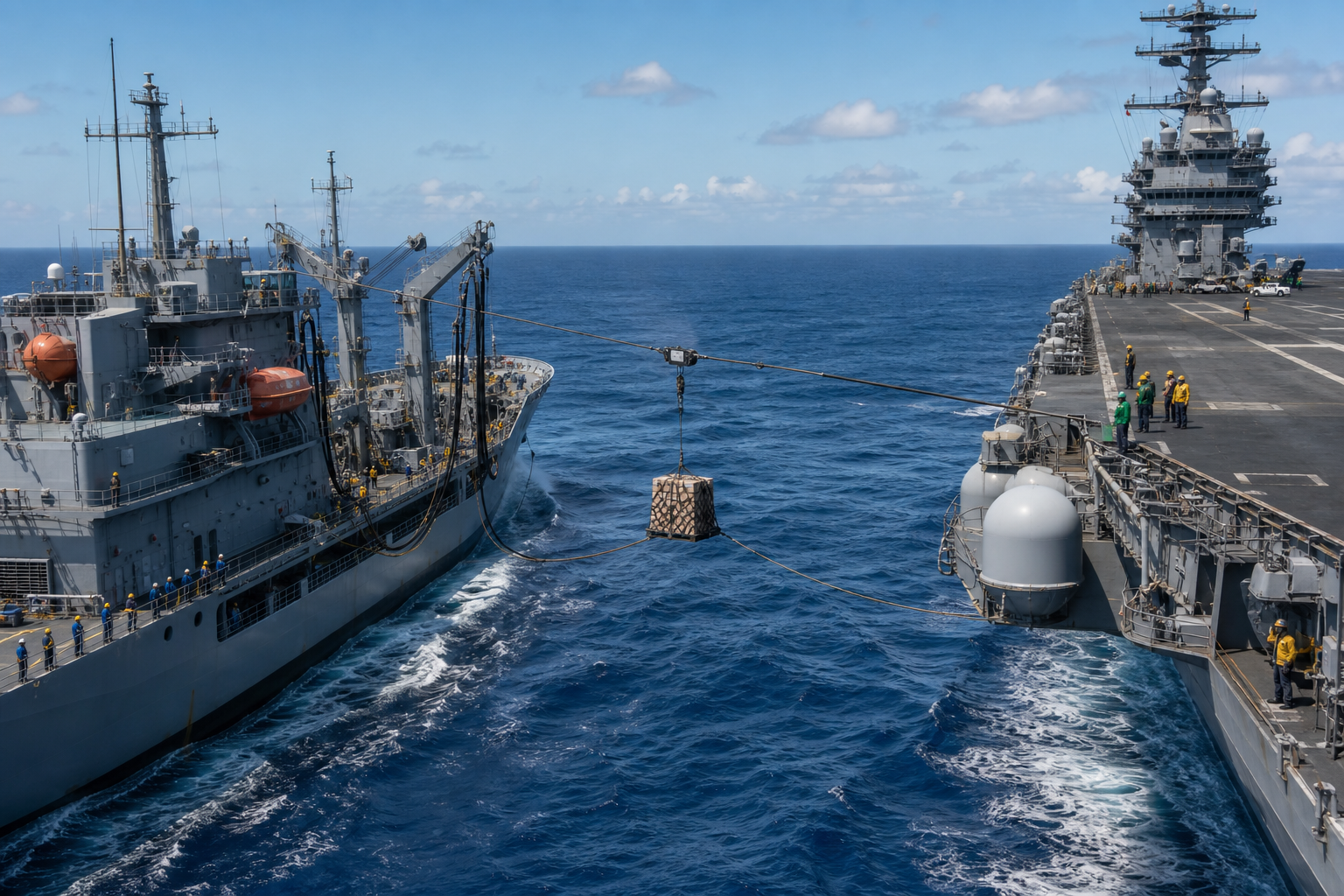
A naval supply ship transfers a pallet to an aircraft carrier during an underway replenishment

How Ships Get Food, Water, Mail, and Supplies at Sea

Why can't they just deliver fresh food?

That question came up after families of sailors and Marines aboard USS Abraham Lincoln described food, hygiene, mail, water-quality, and crew-welfare problems during an unusually long deployment. The Navy has disputed some of the reporting. In April 2026, the Chief of Naval Operations said the carrier strike group had adequate food supplies. In August, a Navy statement reported by the Associated Press said leadership had prioritized food, then hygiene items, then mail, and that the crew had access to clean water and healthy meal options.
Those statements do not settle every allegation, and this article is not an investigation of one carrier. The public debate does expose a useful question: if a Navy can transfer pallets between moving ships and fly cargo aboard by helicopter, why can it not deliver fresh food whenever it wants?
The first thing to understand is that fresh food is a luxury at sea. That does not mean crews should expect inadequate meals. It means fresh produce, fresh dairy, and other short-lived provisions cannot be the foundation of a ship's food supply during extended operations. Frozen, canned, dried, powdered, and long-life foods provide the dependable inventory that keeps people fed after fresh stores are used up. Receiving new fresh provisions is valuable for variety and morale, but keeping them continuously available is one of the hardest parts of supplying a ship.
I have worked aboard the Navy supply ships that replenished carriers and other fleet vessels, and I have worked as a marine engineer aboard civilian merchant ships, including oil tankers. The short answer is that the ability to physically transfer a pallet is not the same as having an uninterrupted supply chain capable of putting the right pallet in the right place at the right time. The transfer people see in photographs is only the last few hundred feet of a journey that may cover thousands of miles.
The Associated Press account and the Navy's earlier response reported by Navy Times are useful reminders to distinguish reported conditions from confirmed facts.

A ship is a moving, isolated community

A large ship is not simply a vehicle. It is a workplace, power plant, hotel, restaurant, warehouse, waterworks, hospital, and home moving across the ocean. Everyone aboard must eat, drink, bathe, maintain sanitation, repair equipment, and communicate with home while the ship continues its mission.
Ashore, a late truck can be replaced by another truck. At sea, there may be no suitable port nearby, no approved local vendor, no spare aircraft, and no safe transfer window. The receiving ship may also change course or schedule with little notice. That is why maritime logistics must be understood as a chain rather than a delivery appointment.

The supply chain starts ashore

Before food reaches a ship, somebody must forecast demand, buy it, inspect it, consolidate it, keep it at the proper temperature, move it through a port, and load it. Dry stores, refrigerated provisions, frozen food, repair parts, hygiene products, medical supplies, and mail each have different handling and stowage needs.
Fresh food can often be loaded in port, but not every port is an equal source. A ship operating from a remote location may find limited quantities, poor quality, or products that do not meet required standards. In an unfriendly area, a dependable local supply chain may not exist at all. Even good provisions can lose quality while waiting in a warehouse, crossing a pier, riding aboard a supply ship, or sitting in a crowded refrigerated space.
Loading is work. Pallets must be staged, checked, lifted, struck below, broken down, and fitted into finite storerooms. The same process happens in reverse when waste, empty handling gear, or other material comes off. Refrigeration machinery must keep running throughout. For more on the equipment behind those spaces, see engineering systems aboard ships.

Who supplies the supply ship?

This is the step most people miss. A replenishment ship does not manufacture lettuce, toilet paper, spare parts, or mail. It must first receive those items from shore before it can carry them forward. In some cases, it may receive fuel or cargo from another logistics vessel.
The 2026 Military Sealift Command handbook describes Combat Logistics Force ships as civilian-crewed vessels that deliver fuel, ordnance, food, repair parts, and stores so combatants can remain on station. MSC has also publicly documented consolidated operations in which tankers transfer fuel or cargo to logistics ships at sea. In other words, the chain may look like this:
  • vendor or depot to a shore logistics hub;
  • hub to a Combat Logistics Force ship;
  • logistics ship across the ocean to the receiving ship;
  • receiving ship's deck to its storerooms, galleys, shops, and crew.
If any link is late, unavailable, improperly prioritized, or carrying the wrong inventory, a perfectly executed transfer at sea cannot fix what never reached the supply ship.

UNREP: the final few hundred feet

Underway replenishment, or UNREP, is the broad term for supplying a ship at sea. Official MSC material describes two principal methods: connected replenishment, commonly called CONREP, and vertical replenishment, or VERTREP.
During a connected replenishment, two ships steam alongside one another while hoses and tensioned cable systems transfer fuel and cargo. Pallets do not simply swing across on an improvised rope. Trained bridge teams, deck crews, rig teams, engineers, and supply personnel must coordinate a controlled evolution between moving vessels. Weather, sea state, equipment condition, staffing, cargo preparation, and competing missions all affect whether and when it can happen.
MSC's public description of USNS Robert E. Peary's replenishment mission provides a useful high-level explanation of connected and vertical replenishment without getting into sensitive operating details.

VERTREP: when supplies arrive from above

In a VERTREP, helicopters move prepared loads between ships. This can deliver food, mail, parts, and other priority cargo without bringing the ships alongside. It is an impressive capability, but “just fly it over” still begins with the same upstream questions: Is the cargo available? Has it reached the logistics ship or shore airfield? Is an aircraft available? Are the load, deck, weather, visibility, and flight schedule suitable?
Helicopters also have finite time and capacity, and the most urgent load may be a repair part, medicine, or mission-critical equipment rather than fresh produce. UNREP and VERTREP provide options; neither creates an unlimited supply chain.

What it takes to feed an aircraft carrier

Scale changes everything. The Navy has described Nimitz-class carriers as floating communities of about 5,000 sailors and Marines, although the exact population changes with ship's company, the embarked air wing, staffs, and the mission. At three meals per person, 5,000 people represent about 15,000 meal servings every day. That is an illustration, not a precise loading figure: watch schedules can require additional meal periods, and actual demand varies.
An official Navy history of USS Nimitz lists capacity for 18,000 meals per day. Another Navy article reported that USS Abraham Lincoln was serving four meals a day to more than 5,000 sailors during a demanding training cycle. Those figures show why a seemingly generous quantity of provisions can disappear quickly.
Fresh produce and dairy have limited lives. Frozen food, canned goods, dry stores, powdered eggs, and long-life milk extend endurance and are normal tools of shipboard feeding. Their presence alone is not evidence of neglect. But nutrition, portion size, variety, food quality, and the simple fact that food is available are separate questions.

Food is also a crew-welfare system

Anyone who has spent a long time at sea understands that meals organize the day. Steak, lobster, hamburgers, holiday dinners, or a barbecue on deck can break monotony and give the crew something to anticipate. These meals are often used deliberately to support morale.
Context matters in both directions. A steak dinner does not prove that no shortage occurred, and powdered eggs do not prove that a crew was mistreated. A fair assessment asks what food was available, in what quantity, for how long, and whether it met health and welfare needs.

Food must arrive; ships can make freshwater

Food and spare parts normally have to reach the ship. Much of a ship's freshwater can be produced aboard. Depending on the vessel, that may be done with distilling plants, often called evaporators, reverse-osmosis units, or another arrangement.
An evaporator uses heat and reduced pressure to boil seawater at a lower temperature. The vapor leaves salts behind, then condenses as distillate. A reverse-osmosis unit uses pressure to force pretreated seawater across membranes that reject most salts. NAVSEA's explanation of an advanced shipboard RO unit describes the same basic principle in plain language.
I have operated both types of plant. I have also dealt with high-salinity product water, failed evaporators, and failed RO units. The ability to make water does not mean water is guaranteed: machinery requires power, maintenance, working controls, suitable operating conditions, and people who can recognize when the product is not acceptable.
Shipboard water production is one part of the larger collection of systems explained in how ships work and in our overview of what marine engineers do.

Freshwater is not automatically safe drinking water

Producing low-salinity water and maintaining safe potable water are related but distinct jobs. Water intended for drinking and domestic use must be directed into the correct system, disinfected as required, protected from cross-connections, stored in suitable tanks, distributed through dedicated piping, and tested.
On ships I worked aboard, potable water was chlorinated or brominated and residual disinfectant was checked at end-use points, including distant parts of the system. That helps show whether protection remains throughout the distribution network. Exact chemicals, limits, sampling frequency, and corrective actions depend on the vessel and governing procedure.
When taking water from shore, the source and the connection both matter. Dedicated hoses, sanitary handling, protected filling connections, and measures against backflow and cross-contamination are part of keeping safe water safe. The World Health Organization's Guide to Ship Sanitation treats bunkering, onboard production, storage, and distribution as one risk-managed water chain.

Not all freshwater aboard serves the same purpose

Distillate describes how water was produced, not every way it may be used. Depending on vessel design, produced water may be directed toward a potable-water system or become the starting water for boilers, closed-loop cooling systems, and other machinery. Each use can require different chemical treatment and purity.
These systems are not interchangeable. Boiler feedwater, condensate, treated cooling water, potable water, and seawater cooling all describe different functions or circuits. Some vessels use seawater directly on one side of a heat exchanger and treated freshwater in a closed loop on the other. Toilet flushing may use freshwater, seawater, or another configured system. There is no single piping diagram that represents every ship.

When water production or treatment goes wrong

High salinity can prevent produced water from being accepted for its intended service. Evaporators and RO units can fail or lose capacity. Treatment equipment can under-dose or over-dose disinfectant. Tanks and distribution systems can also create problems even when the production plant itself is healthy.
On ships I worked aboard, multiple potable-water tanks gave us operating options. If testing showed a problem with the water being supplied, an engineer could sometimes isolate that tank and place a suitable tank in service while the problem was investigated. That is an example from my experience, not a universal casualty procedure.
Tank selection also exists within the ship's larger loading condition. For example, I have drawn from a potable-water tank on the low side of a ship to reduce a small list as the water was consumed. Freshwater inventory contributes to weight distribution, but potable tanks are not ballast tanks, and ships normally use dedicated ballast and stability-management arrangements. Water quality, system configuration, and approved procedures still govern what engineers can do.

Mail carries little weight but enormous importance

Mail follows its own long chain. USPS routes Fleet Post Office mail toward military processing and fleet mail facilities; the Navy then has to route it toward a ship whose location and schedule may change. It may eventually reach the crew in port, aboard a logistics ship during replenishment, or through carrier onboard delivery aircraft when that option is available.
Delivering mail to a deployed ship requires constant coordination between postal facilities, shoreside support personnel, logistics units, and the ship itself. Mail may move through several hubs before it reaches a port, supply ship, or aircraft positioned to make the final delivery. None of those routes guarantees a fixed delivery date to a vessel whose location and schedule can change with little notice.
In my experience, the ship and shore team coordinate where the vessel is expected to be and when. Those plans are not always reliable because the ship's schedule changes. A parcel can make it across a continent and an ocean, then miss the final connection because the ship had to move.
At sea, ordinary cellular service is usually absent and personal internet may be slow, limited, unavailable, or restricted, particularly aboard a military vessel. Mail delays therefore carry more emotional weight than the cargo itself suggests. For a broader look at that limitation, see internet access at sea.

Ships are not normal living environments

Ships are not normal shoreside environments, and they cannot always be judged by shoreside expectations. Professional civilian mariners and U.S. Navy sailors are trained to work through conditions that much of the general public would find unusual or uncomfortable. Limited menu choices, running low on a particular product, going without fresh produce, or not receiving mail for weeks can all be normal and expected parts of life at sea.
Mariners also understand that equipment breaks, schedules change, weather closes transfer windows, and the most important supplies sometimes take priority over comfort or variety. A temporary shortage of one item does not necessarily mean the ship is unsafe, neglected, or incapable of completing its mission. Adapting to those limitations is part of the job.
There is still a meaningful difference between routine shipboard austerity and a prolonged failure to provide adequate nutrition, safe potable water, sanitation, or habitable living conditions. Evaluating a specific report requires context: what was unavailable, for how long, what alternatives remained, what operational constraints existed, and what corrective action was taken. Conditions can be normal for a ship without being normal for life ashore. Inconvenience should not automatically be confused with an unsafe living condition.

So why can't they just deliver it?

They often can deliver it, but not by skipping the chain. Before a pallet reaches a sailor, procurement, inspection, warehousing, refrigeration, port access, transport, logistics ships, aircraft, crews, weather, schedules, storage, maintenance, and operational priorities all have to line up.
When the system works, most people see only a helicopter lifting a load or two gray ships steaming side by side. The real accomplishment began long before that moment. Understanding that complexity should help us evaluate failures more intelligently. It should never lower the standard owed to the people who live and work aboard.

Share This Article

Related Articles

Continue reading with these related articles

Marine Engineering: Career Overview, Daily Life & Real Dangers
EngineeringPost

Marine Engineering: Career Overview, Daily Life & Real Dangers

Get an inside look at what it means to be a Marine Engineer — from daily responsibilities and shipboard routines to the real dangers that come with working in one of the world's most demanding engineering environments.

How Are Cruise Ships Powered? The Engineering Behind These Floating Cities
EngineeringPost

How Are Cruise Ships Powered? The Engineering Behind These Floating Cities

Discover how cruise ships generate power and propel through the ocean. Learn about diesel-electric systems, azipod propulsion, and the latest innovations in maritime engineering.

Engineering Systems Onboard a Ship: Powering the High Seas
EngineeringPost

Engineering Systems Onboard a Ship: Powering the High Seas

Explore the complex engineering systems that power modern ships, from propulsion and power generation to HVAC and automation systems that keep global trade moving.

A Day in the Life of a Marine Engineer: Part 2
Post

A Day in the Life of a Marine Engineer: Part 2

Continue exploring the responsibilities and challenges faced by marine engineers in their daily work aboard ships.

© 2025 The Salty Mariner. All rights reserved.

Privacy PolicyAccessibilityDisclaimer